



Spice Storage That Saves Time: One-Hand Grab Setup
July 31, 2026
You're mid-recipe with one hand stirring the pan, and the cumin is hiding behind three bottles of paprika you forgot you owned. The onions are getting darker by the second. We've been there, which is why the best spice storage ideas start with one simple test: can you grab any jar with one hand, without looking twice?
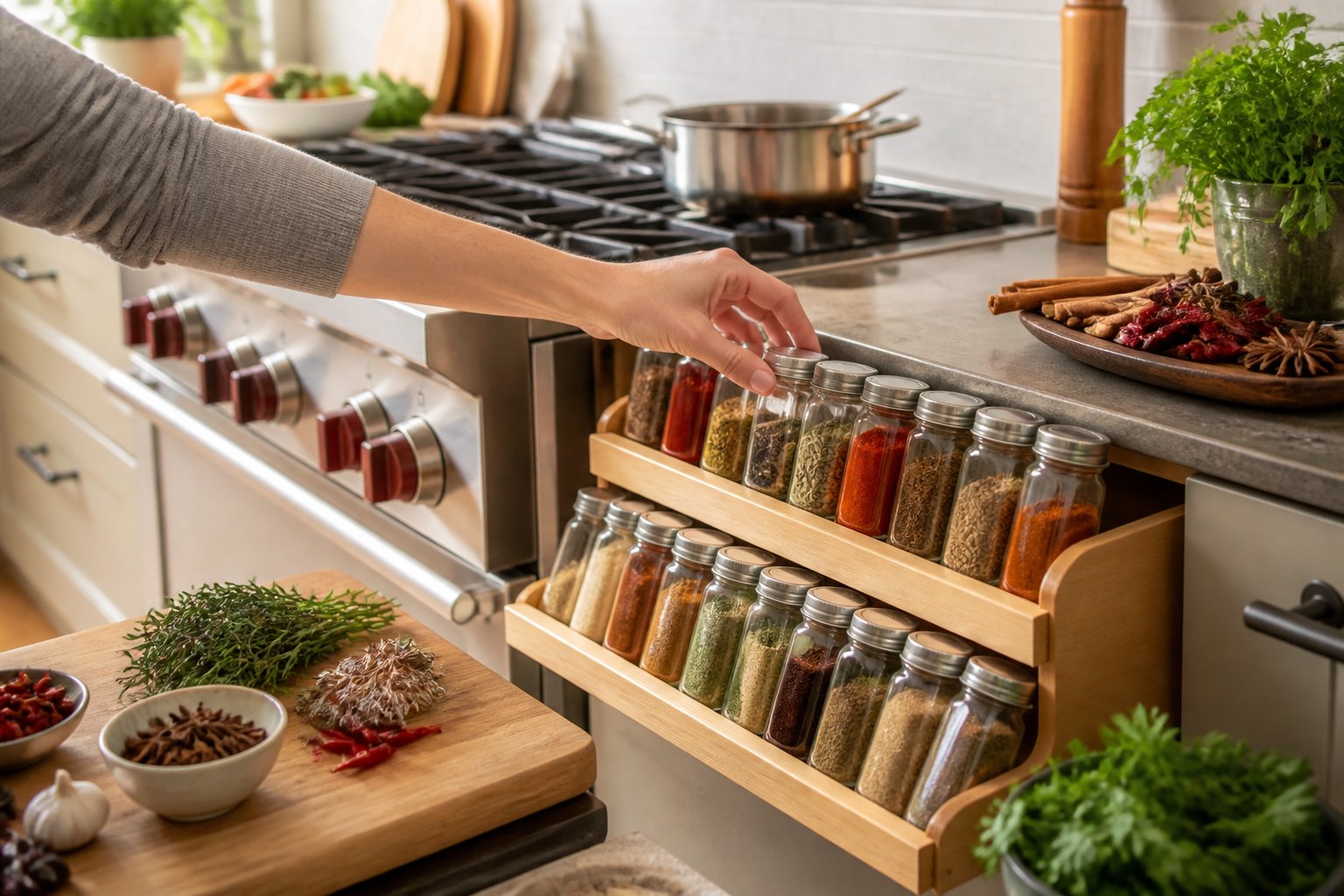
When you're running a home and a business, ten seconds of digging adds up across every meal. The one-hand grab setup means every spice is visible, reachable, and stored in a single layer or single row, so you never move one jar to reach another. That's the whole rule, and it works whether you have a deep drawer, a narrow cabinet, or barely any room at all.
Below, we walk through spice organization that fits real kitchens: drawer spice organizers for flat-lay access, tiered spice racks that lift back rows into view, magnetic spice tins for tight walls, over-the-door spice racks, and countertop spice carousels that stay within arm's reach. Plenty of these are no-drill and renter-friendly, so you can set up spice storage in a small kitchen this weekend and keep it.
Key Takeaways
- A cluttered spice cabinet costs you time and leads to duplicate buys.
- Group and label your spices so any jar is visible and reachable with one hand.
- No-drill drawers, racks, magnets, and carousels fit small kitchens and keep spices fresher.
Why Spice Chaos Slows You Down
Picture this: your pan is hot, the garlic is about to burn, and you're digging through a cabinet with both hands looking for cumin.
That's the real cost of poor spice organization. It's not just messy — it breaks your rhythm at the exact moment you need to move fast.
We see the same problems again and again when we talk with busy cooks:
- Tall bottles hide short ones. Anything in the back row basically disappears.
- Duplicates pile up. You buy paprika because you can't find the paprika you already own.
- Two-handed digging. You set down your spoon, move four jars, then start over.
- Expired jars take up prime space. Old ground spices lose flavor, so they crowd your shelf without earning it.
The fix isn't more shelving. It's a setup you can reach into with one hand while the other keeps stirring.
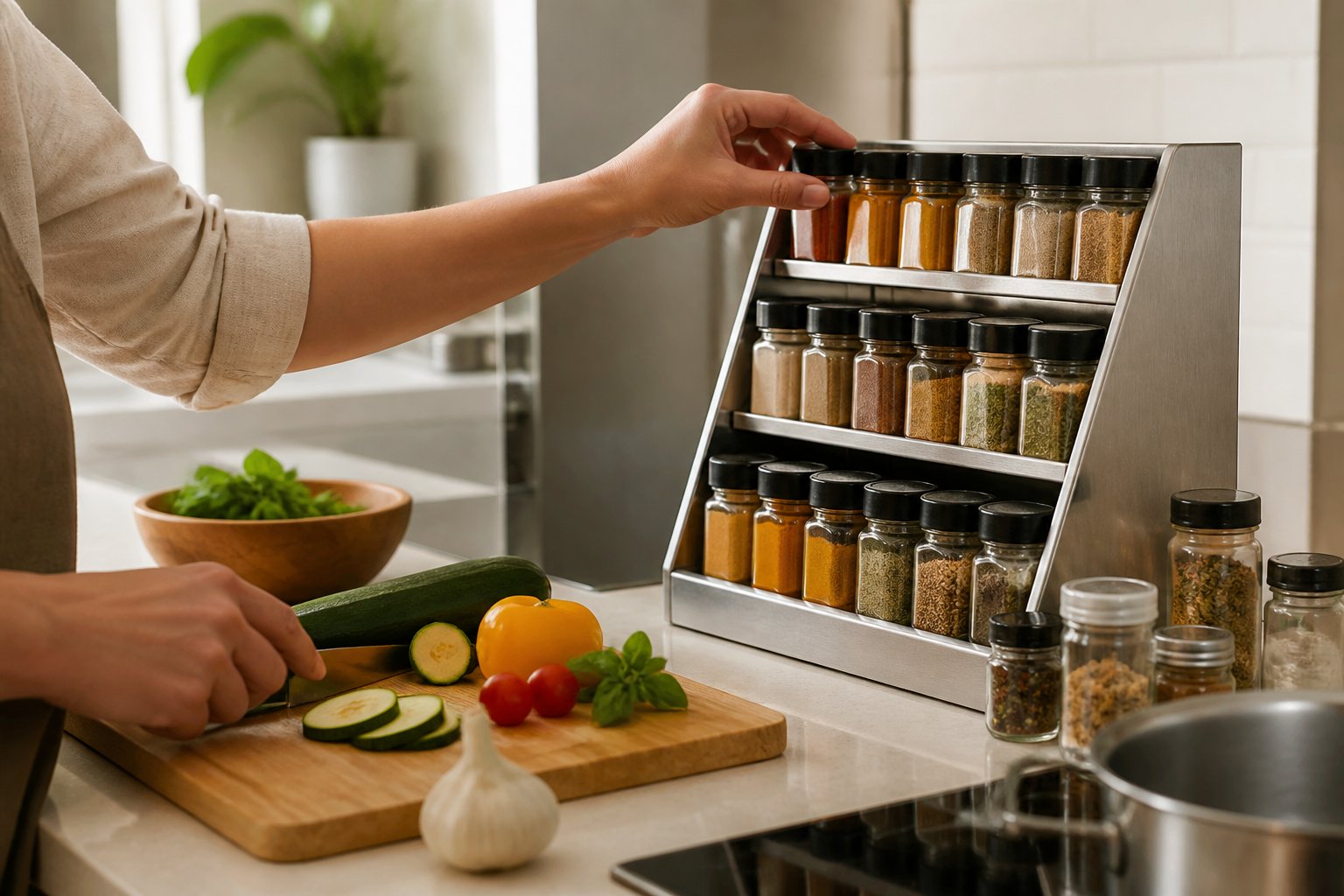
That's the thinking behind most smart spice storage ideas — drawer spice organizers that lay jars flat and label-up, tiered spice racks that lift the back row into view, magnetic spice tins on the side of the fridge, over-the-door spice racks, and countertop spice carousels that spin toward you.
If you're working with spice storage small kitchen limits, the good news is that most of these need zero tools. No drilling, no holes, no landlord conversations.
Learning how to organize spices well saves you a few seconds per grab. Multiply that across a week of dinners, and the difference is real.
The One-Hand Grab Rule: How To Store Spices For Speed
Here's the rule we build every setup around: you should be able to reach any spice, open it, and use it with one hand. Your other hand is busy stirring, holding a lid, or steadying a cutting board.
That single test changes how to organize spices. If you have to move three jars to reach a fourth, the system is slowing you down.
Three things make one-hand grabbing work:
- Visibility — you can read every label without lifting anything
- Single depth — no jars hiding behind other jars
- Arm's reach — everything sits within one step of your stove or prep area
Once you apply those rules, the right tools become obvious. Drawer spice organizers tilt jars so labels face up. Tiered spice racks lift back rows into view inside a cabinet.
Magnetic spice tins keep small amounts on a metal surface, and over-the-door spice racks use space you already own. A countertop spice carousel spins your ten most-used blends into reach.
Renting? You still have options. Most of these spice rack ideas need no drilling — drawer inserts, tension-mounted racks, and adhesive strips all come out clean.
For spice storage in a small kitchen, we suggest starting with one shallow drawer or the inside of a cabinet door. You don't need more room, just a smarter layout.
Good spice organization isn't about owning matching jars. It's about cutting the seconds you lose searching, and these spice storage ideas do exactly that.
Sort First: Declutter And Group Your Spices
Before you buy a single organizer, empty the whole cabinet onto your counter. We know it looks like a mess for a few minutes, but this step decides how well every other system works.
Check dates as you go. Ground spices usually hold flavor for about one to two years, and whole spices last three to four years. If a jar smells like dust instead of the spice on the label, let it go.
Now group what's left. This is the part that makes one-hand grabbing possible later.
Try sorting into four piles:
- Daily drivers — salt, pepper, garlic powder, paprika, cinnamon
- Weekly regulars — cumin, oregano, chili powder, curry blends
- Occasional — cardamom, saffron, holiday baking spices
- Duplicates — combine two half-full jars of the same thing
Your daily drivers deserve the best real estate. Keep them at the front of a drawer spice organizer, on the lowest shelf of a tiered spice rack, or on a countertop spice carousel right by the stove.
Occasional jars can move to the back, to an over-the-door spice rack, or to a high shelf.
Some cooks prefer sorting by cuisine instead of frequency — all your taco night spices together, all your baking spices together. Both work. What matters is that you know where things live.
If you're figuring out how to organize spices in a tight space, this sorting step matters even more. Spice storage small kitchen setups only fail when you try to fit everything into prime spots.
Best Spice Storage Solutions For Small Kitchens
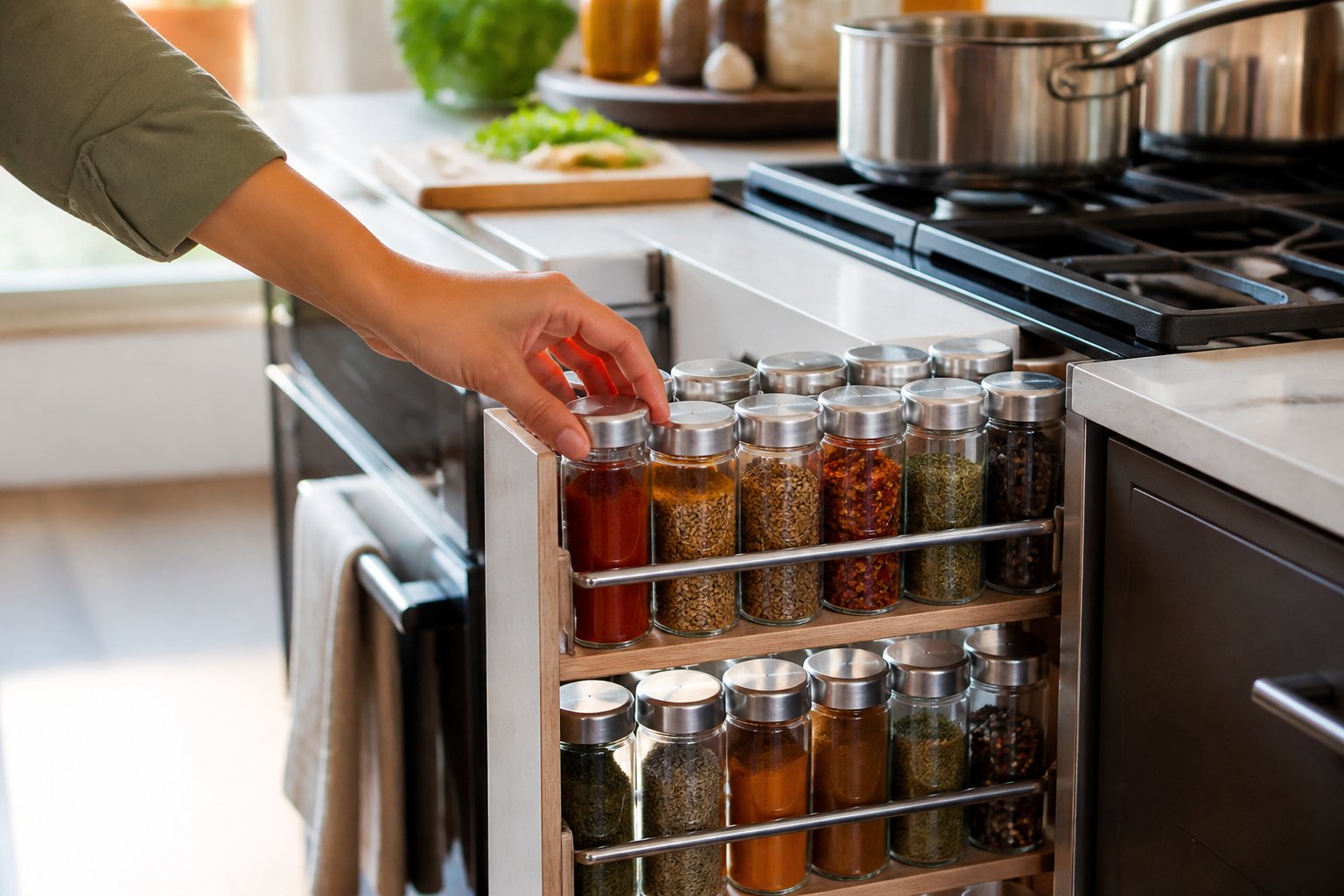
When counter space is tight, the goal stays the same: you should be able to reach for cumin with one hand while the other stirs the pan.
Here are the spice storage ideas we come back to most, and who each one suits best:
| Solution | Works best when | One-hand grab? |
|---|---|---|
| Drawer spice organizers | You have a shallow drawer near the stove | Yes — labels face up, no digging |
| Tiered spice racks | Jars live inside a deep cabinet | Yes — back rows stay visible |
| Magnetic spice tins | Wall or fridge side is empty | Yes — lift and twist with your thumb |
| Over-the-door spice racks | Cabinet or pantry doors are free | Yes — everything sits in one row |
| Countertop spice carousels | You cook with the same 12 spices daily | Yes — one spin, one grab |
For a spice storage small kitchen setup, start with vertical space. The inside of a cabinet door, the wall beside your range, and the side of your fridge are usually unused.
Renting? Look for adhesive strips, tension-fit shelves, and racks that hook over a door. No drill, no holes, no deposit worries.
Our rule for how to organize spices: keep your top ten within arm's reach of the stove, and store backups elsewhere.
Group by how you cook, not alphabetically. Baking spices in one spot, savory blends in another.
Good spice organization means fewer pauses mid-recipe, and the best spice rack ideas are simply the ones that match your kitchen's layout.
Drawer Spice Storage: The Flat-Lay Method
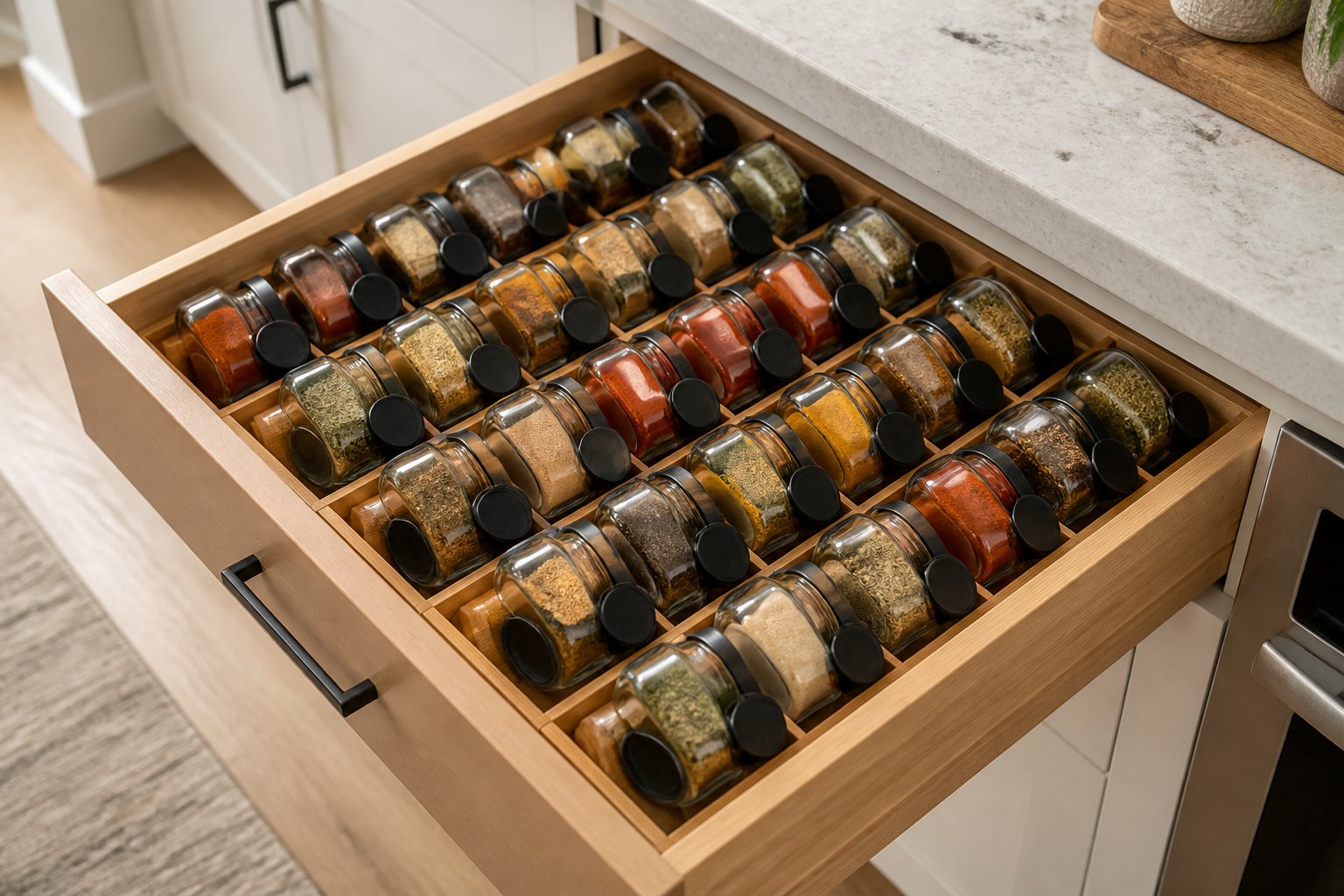
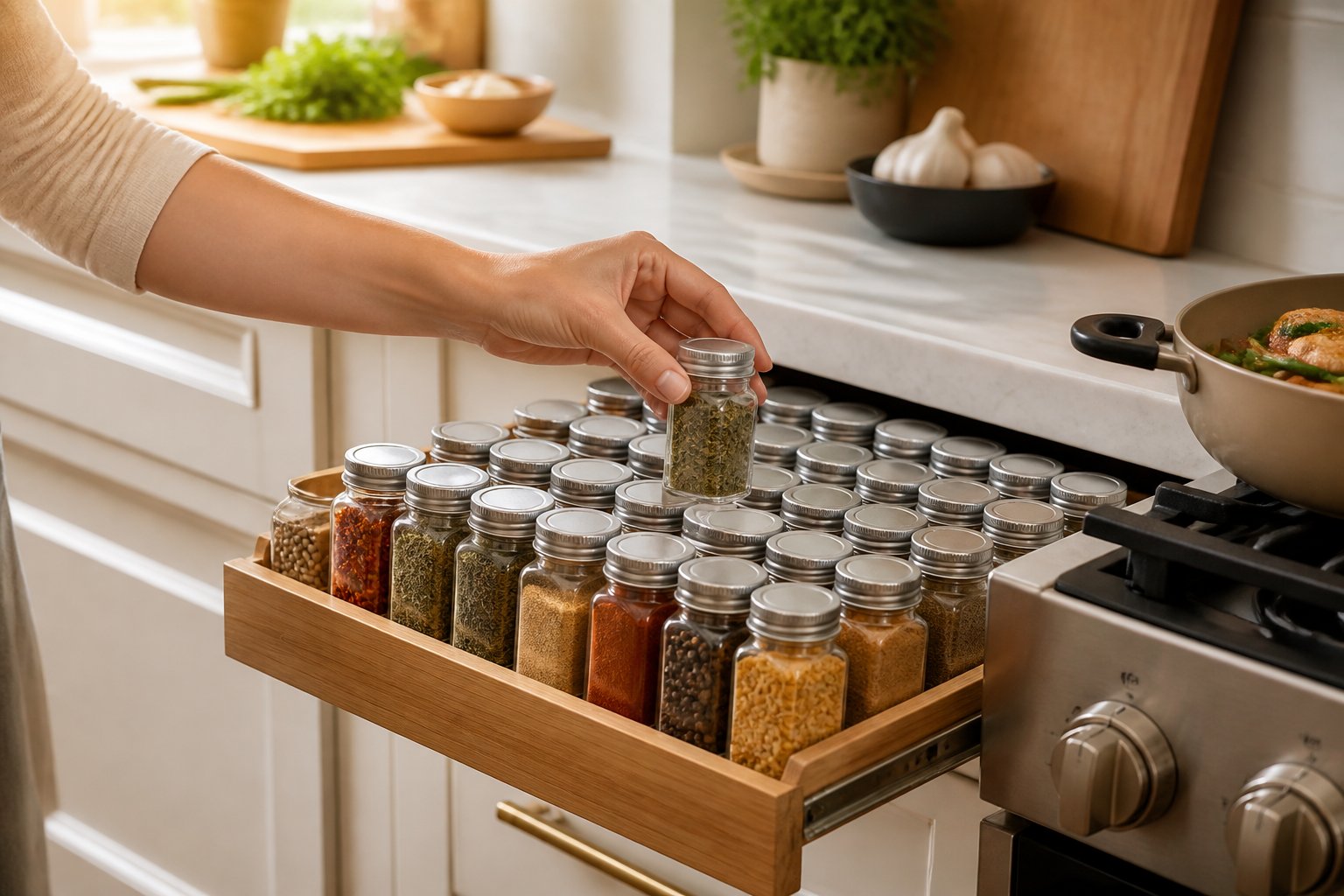
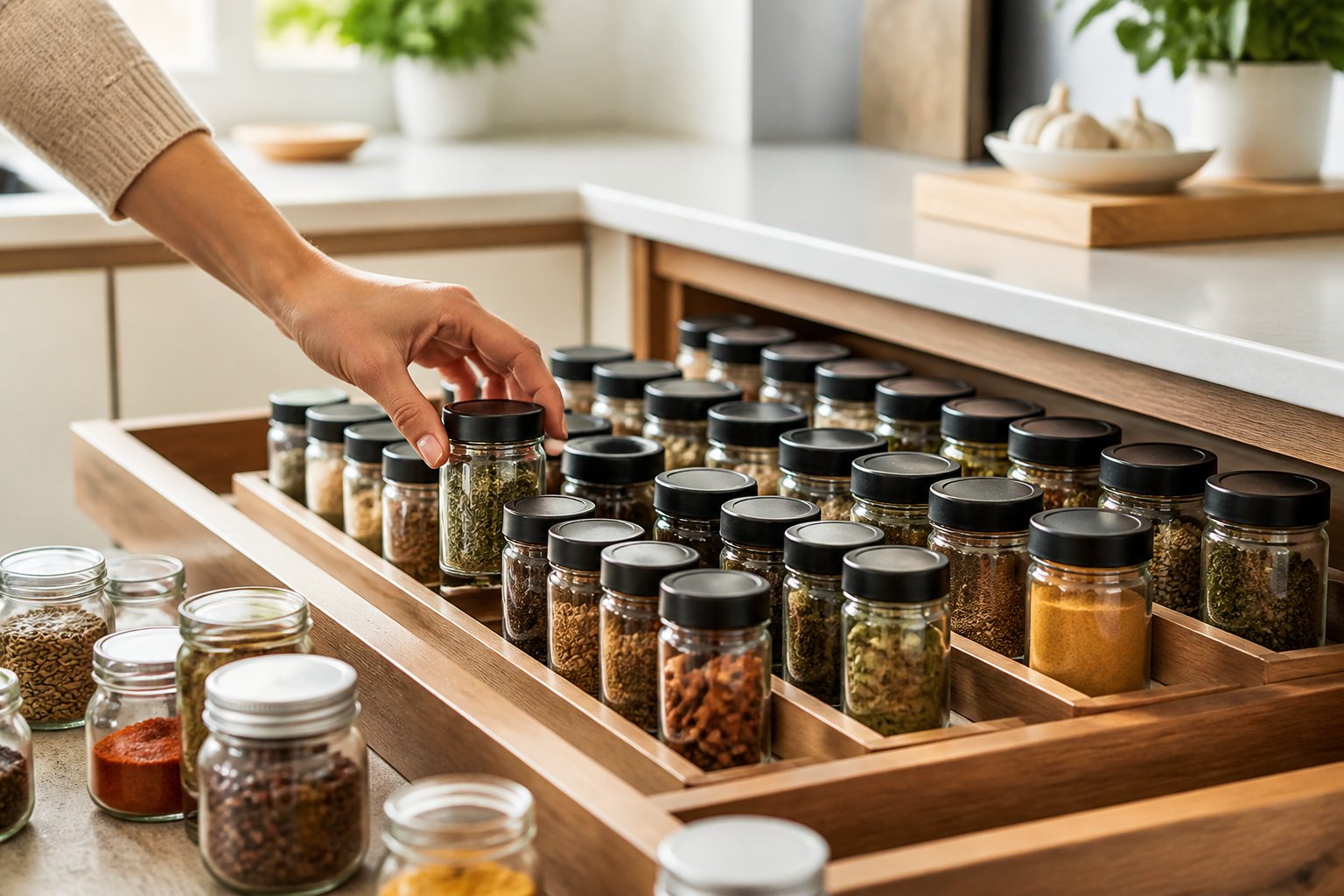
If you have a spare kitchen drawer, you already have one of the best spots for spices. Laying jars on their side with the labels facing up turns the whole drawer into a single view you can scan in seconds.
We like this method because it works with one hand. You open the drawer, spot the label, and lift the jar straight out — no shuffling bottles or moving the front row to reach the back.
How to organize spices in a flat-lay drawer:
- Empty the drawer and toss anything past its date.
- Measure the drawer's width, depth, and inside height before buying anything.
- Add an insert — angled tiers or flat liners both keep jars from rolling.
- Label the lids, not just the sides.
- Group by how often you cook with them, and keep your daily eight closest to the front.
Most drawer spice organizers sit between 2 and 2.5 inches tall, so check that your jars fit under the counter above.
| Drawer depth | What tends to fit |
|---|---|
| Shallow (under 3") | Flat single layer, labels up |
| Medium (3–4") | Angled two- or three-tier insert |
| Deep (4"+) | Tiered insert with taller jars |
No drilling, no wall damage, nothing screwed in — which makes it one of the easier spice storage ideas for renters.
Short on drawers? Tiered spice racks, magnetic spice tins, over-the-door spice racks, and countertop spice carousels cover the same goal with a different footprint.
Wall And Door-Mounted Spice Racks (No-Drill Options)
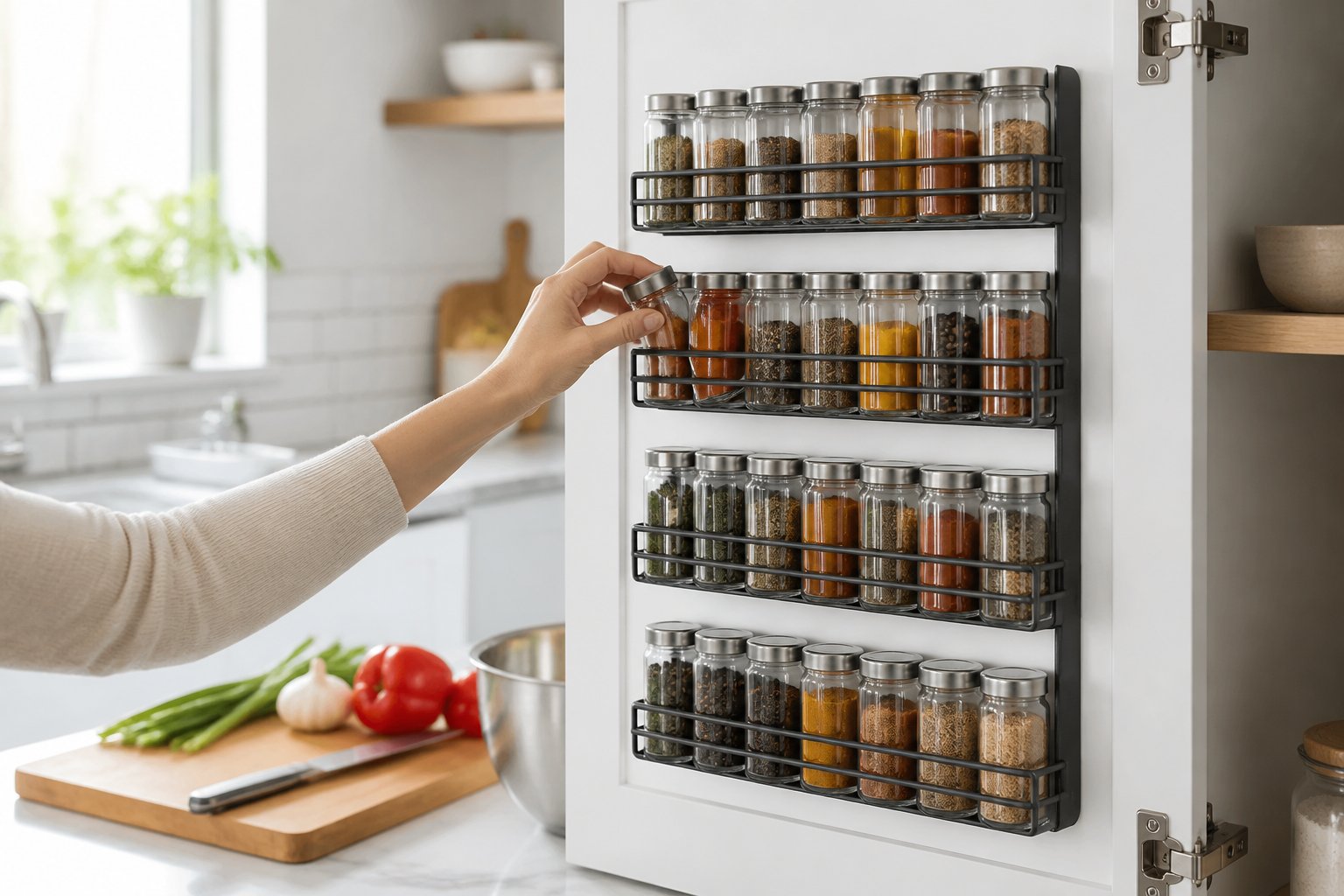
When counter space is tight, the wall is your best friend. Mounting your spices at eye level means you can reach up and grab one jar with your free hand while the other stirs the pan.
The good news for renters: you don't need a drill. Many racks now come with strong adhesive strips that hold on flat, smooth surfaces like cabinet doors, tile backsplashes, or the side of a fridge.
Where to mount, and what works best:
| Spot | Best rack type | Mounting method |
|---|---|---|
| Inside cabinet door | Slim shelf racks | Adhesive or hook-over |
| Pantry door | Over-the-door spice racks | Hangs on the door frame |
| Backsplash wall | Single or double-tier shelves | Adhesive strips |
| Fridge side or hood | Magnetic spice tins | Magnets, no tools |
A few things we've learned about spice organization on doors and walls:
- Keep jars one row deep so nothing hides behind anything else.
- Label the tops and the fronts so you can spot a jar from any angle.
- Check the weight limit before loading up glass jars.
- Leave a little space above each shelf so jars lift out easily.
Over-the-door spice racks are a smart pick for spice storage small kitchen setups, since they use a space that's usually empty.
If your cabinet doors are textured or painted, adhesive may not grip well. In that case, tiered spice racks or drawer spice organizers give you the same one-hand access without touching the walls.
Magnetic Spice Storage For Tight Spaces
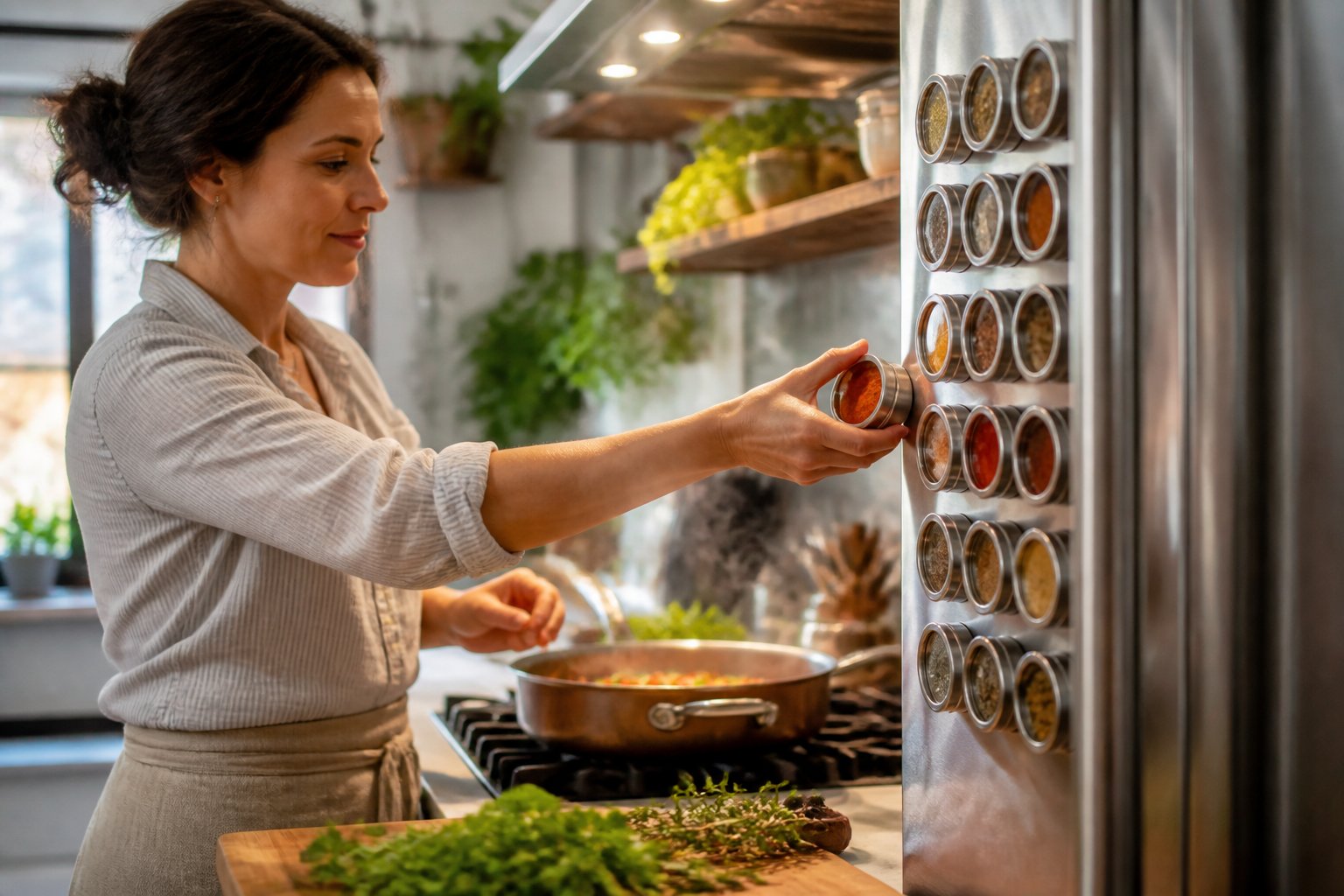
When cabinet space runs out, look at the side of your fridge. Magnetic spice tins stick right to steel surfaces, so you free up shelves without giving up counter room.
We like this option for anyone who can't drill holes. It's one of the simplest spice storage ideas for renters, and you can move the whole setup on moving day.
Most magnetic tins hold about 1.5 to 3 ounces. Many have clear or windowed lids so you can see what's inside at a glance.
What to look for:
| Feature | Why it matters |
|---|---|
| Strong magnet | Holds when you pull with one hand |
| Clear top or side window | You spot the spice without lifting it |
| Shaker and pour openings | Lets you season straight into the pot |
| Airtight seal | Keeps ground spices fresher longer |
A quick note on how to organize spices this way: put your daily eight or ten within arm's reach of the stove, and place backups higher up.
Test your fridge first. Some stainless steel doors aren't magnetic, though the side panels often are. A metal strip, a magnetic knife bar, or the range hood can work instead.
Magnetic racks are another route. They're flat shelves that hold standard jars, and they pair well with tiered spice racks or drawer spice organizers if you use both.
For spice storage small kitchen problems, this is one of the spice rack ideas that adds storage without taking any floor space. Label the lids and tops so your labels face you no matter the angle.
The All-in-One Rotating Countertop Organizer

If you cook most nights, the things you reach for most shouldn't be scattered across drawers and cabinets. A rotating countertop organizer keeps your spices, utensils, knives, and condiments in one spot within arm's reach — no screws, no wall anchors, no digging.
Here's what makes it faster than a plain spice rack: it holds everything at once. The upright 8.9" section stands your spatulas, ladles, and whisks ready by the pan. A built-in knife block keeps blades in dedicated slots, a four-slot caddy holds your condiments, and four spice containers sit right at the base. Then the whole thing spins a smooth, silent 360° — one light turn brings whatever you need to your hand while the other keeps stirring.
Why one rotating organizer beats five separate holders:
- 360° rotating base — spin to any tool or spice, no reaching over or moving things
- Upright 8.9" utensil holder — spatulas, ladles, and whisks stand ready and visible
- Built-in knife slots — blades stay safely tucked, not loose in a drawer
- Four spice containers + condiment caddy — your everyday spices and sauces in one reach
- Wide, stable 9.6" base — stays put when you reach in, no wobble or tipping
For spice storage in a small kitchen, this is the piece that clears your counters instead of cluttering them. One compact unit replaces a spice rack, a utensil crock, and a knife block — and the top section lifts off in seconds for cleaning.
One habit that helps: place it between your stove and cutting board, not beside the sink. That short distance is what makes it actually save you minutes.
No drilling and fully portable — set it on the counter, the kitchen island, or move it to the dining table as a condiment station at dinner. Lift it, wipe the counter, set it back down. That makes it one of the easier spice rack ideas for renters, too.
Labeling And Arranging Spices So You Find Them Fast
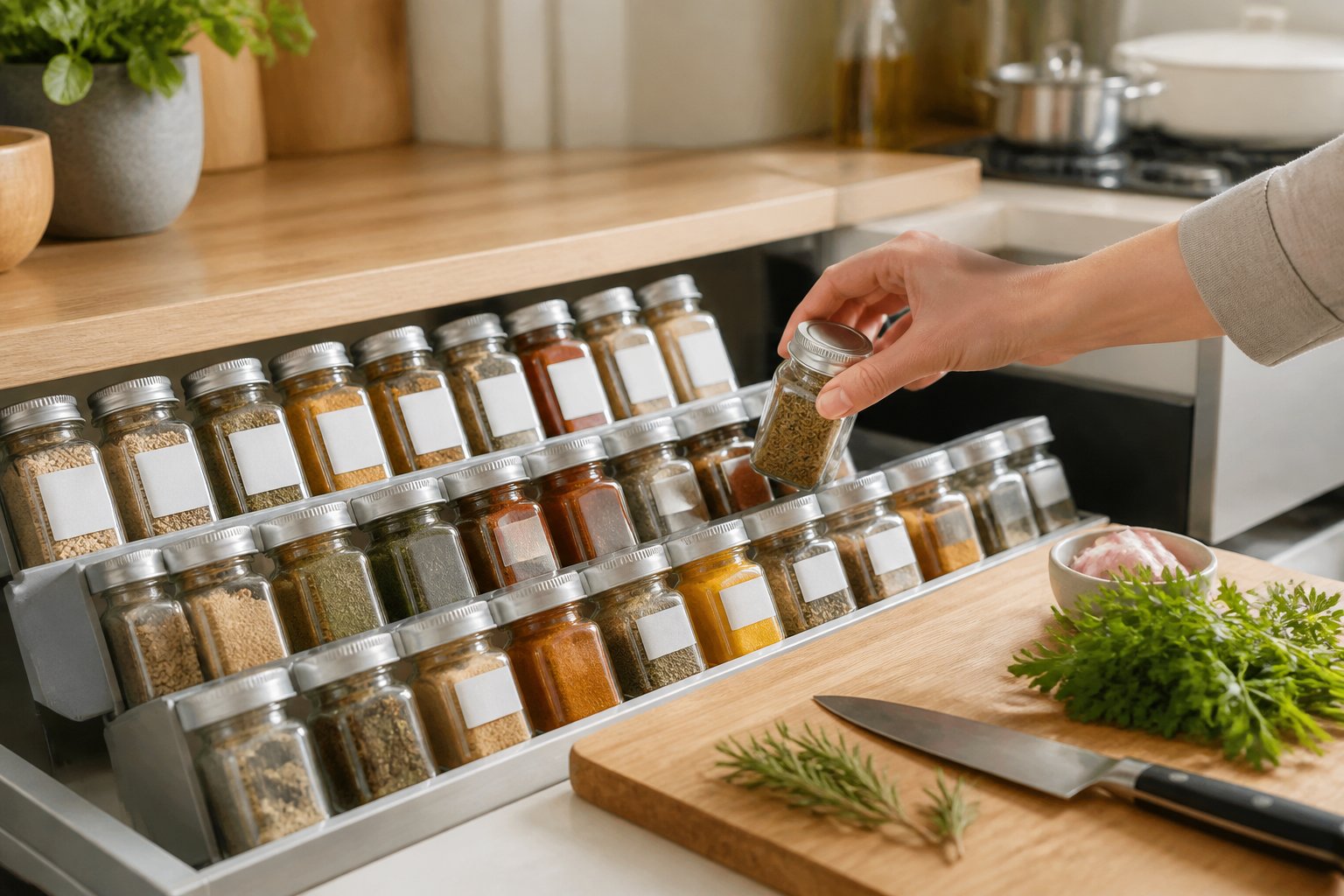
Labels do the heavy lifting here. When you can read a name without lifting a jar, you stop digging and start cooking.
We suggest labeling the top and the side of every container. Tops work for drawer spice organizers, and sides work for tiered spice racks or shelves where you see the jars face-on.
Keep the text large and simple. Cumin beats Ground Cumin, Organic every time.
Then arrange by how often you reach for something, not by the alphabet. Alphabetical order looks tidy, but it buries your salt behind your saffron.
Here's the zone method we use when we plan spice organization:
| Zone | What goes there | Best fit |
|---|---|---|
| Front and center | Daily salt, pepper, garlic powder | Countertop spice carousels, magnetic spice tins |
| Middle reach | Weekly cumin, paprika, cinnamon | Drawer spice organizers, tiered spice racks |
| Back or high | Holiday and rare blends | Over-the-door spice racks |
Group by how you cook, too. A baking cluster and a taco night cluster cut your search time more than any alphabet system.
For spice storage small kitchen setups, uniform jars matter. Matching heights mean nothing hides, and one hand can pull a tin free without knocking others over.
Most of these spice rack ideas need no drill, so renters can set them up and take them along. That's the practical side of spice storage ideas and how to organize spices in a way that lasts past the first busy week.
How To Keep Spices Fresh Longer
Fast access only helps if what you grab still tastes like something. Four things wear spices down: heat, light, air, and moisture.
That means the rack above your stove is the worst spot, even though it feels convenient. We suggest moving that collection into a drawer, a cabinet away from the oven, or a closed pantry shelf.
Here's what we watch for when we plan spice organization:
- Airtight lids — screw-top jars and magnetic spice tins seal better than shaker caps left open.
- Dry spoons only — never shake spices over a steaming pot, since humidity clumps the powder.
- Small batches — buy what you'll use in a year instead of the bulk jar.
- Clear labels with dates — a quick note on the lid tells you what's still good.
General shelf life, once opened:
| Type | Keeps about |
|---|---|
| Whole spices (peppercorns, cinnamon sticks) | 3–4 years |
| Ground spices (paprika, cumin) | 2–3 years |
| Dried herbs (basil, oregano) | 1–3 years |
| Seasoning blends with salt or garlic | 1–2 years |
The smell test settles it. Rub a pinch between your fingers — if the aroma is faint, the flavor will be too.
Good storage and easy reach can work together. Drawer spice organizers, tiered spice racks, over-the-door spice racks, and countertop spice carousels all keep jars upright, shaded, and grabbable with one hand.
For a spice storage small kitchen setup, we lean toward no-drill spice rack ideas — adhesive strips, tension-fit shelves, and stackable trays that renters can take with them.
Conclusion
The best spice storage ideas share one trait: you can reach the jar you need without setting down your spoon.
Start with the spices you use weekly. Put those within arm's reach of the stove, and move the rest to a back shelf or a labeled bin.
Then pick the setup that fits your space, not someone else's kitchen:
| Your Space | Try This |
|---|---|
| Deep drawers | Drawer spice organizers with angled slots |
| Tall cabinets | Tiered spice racks so labels stay visible |
| Steel fridge or backsplash | Magnetic spice tins |
| Narrow pantry | Over-the-door spice racks |
| Open counter | Countertop spice carousels |
If you rent, stick with no-drill options. Over-the-door racks hook onto existing doors, magnetic tins need no hardware at all, and drawer inserts simply drop in place.
For spice storage in a small kitchen, go vertical and use doors. Those surfaces are usually empty, and they keep your counters clear for prep work.
A few habits keep your spice organization from slipping:
- Label lids and fronts so you can read them from any angle
- Keep jars out of direct heat and sunlight
- Write the purchase date on the bottom
- Toss duplicates instead of storing both
Knowing how to organize spices saves a few minutes on every meal, and those minutes add up when you're cooking between calls and school pickups.
Test one change this week. If your favorite spice rack ideas make dinner smoother, keep them — and build the rest of your system around that win.
Frequently Asked Questions
Below you'll find answers about jar sizes, cabinet depth, drawer inserts, and labeling methods that keep every spice within one-handed reach. We've pulled together the questions we hear most from cooks who want faster prep without giving up counter space.
What is the best spice organizer for quick one-handed access?
The best option is the one that holds each jar in a fixed spot so you can grab it without steadying anything else with your other hand.
Drawer spice organizers do this well. Angled inserts tilt jars toward you so the labels face up, and the jar stays put when you lift its neighbor.
Countertop spice carousels are a close second. A single spin brings the jar you want to the front, and good ones have a weighted base so they don't slide.
Magnetic spice tins work if you cook near a steel surface or a mounted plate. You pull one tin off with your thumb and two fingers, then press it back without looking.
Skip deep two-row racks for daily cooking. You end up moving front jars to reach back ones, which means both hands.
How can I organize spices to save space in a small kitchen?
Use vertical space and the insides of doors. Spice storage small kitchen setups work best when you stop competing for shelf space.
A few approaches that fit tight kitchens:
- Over-the-door spice racks hang on a cabinet door and hold 15-30 jars in about 3 inches of depth. No drilling needed.
- Tiered spice racks raise back rows so you can read every label from the front of a 12-inch shelf.
- Narrow drawer inserts turn a shallow utility drawer into a flat spice bed.
- Magnetic strips or panels use the side of the fridge or a wall gap next to the stove.
Measure your cabinet door clearance before you buy an over-the-door rack. You need room for the rack plus the jars so the door still closes flat.
Also check jar height. Standard 4-ounce spice jars run about 4 inches tall, while bulk jars can hit 6 inches and won't fit under most shelves.
What is the most efficient way to arrange a large spice collection in one cabinet?
Split the collection into two groups first. Daily spices go at the front in one layer, and backups or seasonal items move behind them or to a separate bin.
Then set up the front layer for reach. Two turntables side by side handle round jars better than shelves do, since you can spin instead of shuffle.
For 40 or more jars, we like this pattern:
| Zone | What goes there | Storage type |
|---|---|---|
| Front, eye level | Salt, pepper, garlic powder, paprika, cumin | Tiered rack or turntable |
| Second row | Baking spices, dried herbs | Tiered rack |
| Top shelf | Refills, bulk bags | Labeled bin |
| Door | Small jars, blends | Over-the-door rack |
Group by how you cook, not by the alphabet. If you make chili every week, keeping chili powder, cumin, and oregano together saves more time than sorting A to Z.
How do professional chefs organize and store spices at home?
Most keep a small working set close to the stove and store the rest away from heat. That usually means 8-12 jars within arm's reach and everything else in a cool cabinet.
They also decant into matching containers. Uniform jars sit evenly in drawers and racks, and you can see how much is left at a glance.
Cooks who work with dry rubs often use wide-mouth tins instead of shaker jars. You can dip a measuring spoon straight in with one hand.
One habit worth copying: date the jar when you open it. Ground spices hold their flavor for about a year, and whole spices last two to three years.
Which spice storage solutions work best for drawers, cabinets, and countertops?
Each space has a shape that suits it. Here's how we match spice rack ideas to the spot you have open.
Drawers. Angled or flat inserts, with labels on the lids. A drawer next to the stove is the fastest place to store spices if you have one to spare.
Cabinets. Tiered racks for shelves under 14 inches deep, turntables for deeper ones. Pull-out shelf risers help if your cabinet is tall and mostly empty air.
Countertops. Spice organizer with 360° rotating base — spin to any tool or spice, no reaching over or moving things.
Doors and walls. Over-the-door racks and magnetic panels. Both are renter-friendly, and neither needs a drill.